The question
How many people in each region are looking for work and cannot find it? And does that differ between Saudis and non-Saudis, and between men and women?
The figure
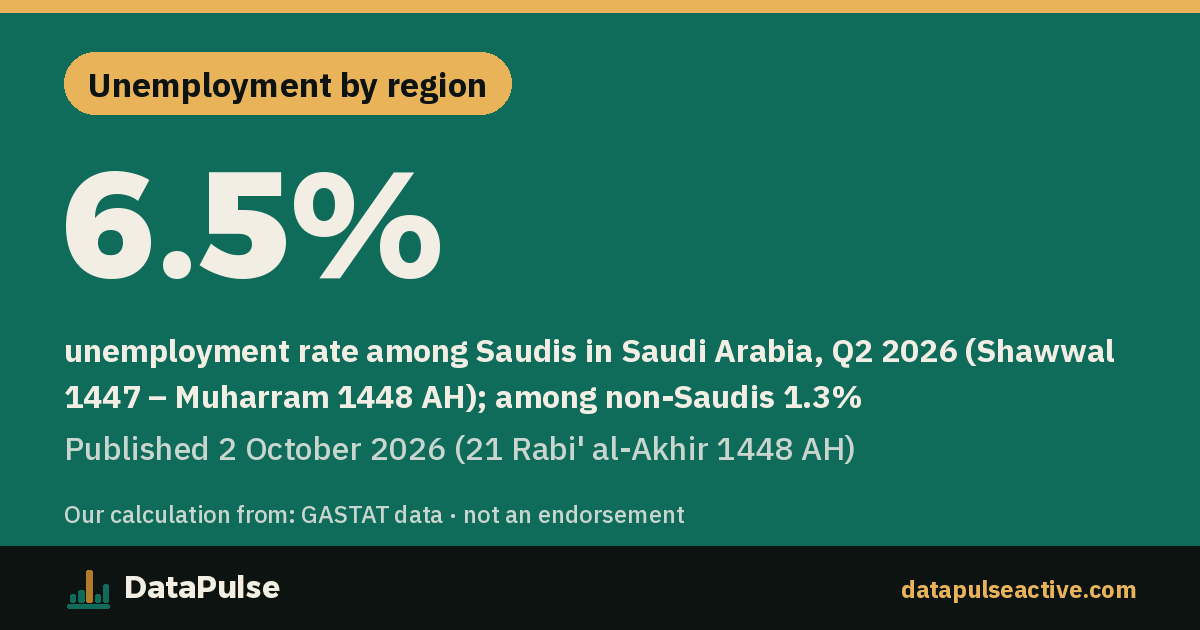
According to GASTAT’s Labour Force Survey, the unemployment rate among Saudis in Saudi Arabia was 6.5% in Q2 2026 (Shawwal 1447 – Muharram 1448 AH), compared with 6.8% in Q2 2025 (Shawwal 1446 – Muharram 1447 AH). Among non-Saudis it was 1.3%, and 3.0% for everyone.
The unemployment rate is the share of people looking for work and not finding it among everyone in the labour force, that is, those working and those looking for work together.
Among Saudi women the rate was 9.6%, and among Saudi men 4.8%; so the rate for women is 2.0 times the rate for men. A year earlier it was 11.3% for Saudi women and 4.3% for men: the rate for women fell and the rate for men rose.
Where is the rate higher, and where lower?
The highest unemployment among Saudis is in Northern Borders, 10.4%, then Jazan, 9.9%, then Madinah, 9.5%. The lowest is in Riyadh, 4.2%, then the Eastern Province, 5.3%, then Najran, 5.6%. So the rate in the highest region is 2.5 times that in the lowest.
Among Saudi women the gap is wider: 17.3% in Tabuk and 4.8% in Najran, and the rate is 10% or more in 9 of 13 regions.
Over the year, the rate among Saudis fell in 5 regions and rose in 8. The largest fall was in Asir, from 9.8% to 8.0%, and the largest rise in Hail, from 6.6% to 8.3%.
For non-Saudis the rate is below 1% in 8 regions, and highest in Najran, 3.0%.
Unemployment among Saudis in Northern Borders is 2.5 times that in Riyadh
Unemployment rate (% of the labour force), Q2 2026 (Shawwal 1447 – Muharram 1448 AH). Highest unemployment among Saudis first.
| Region | Saudis | Saudi women | Saudi men | Non-Saudis | Change in Saudi unemployment over a year (points) |
|---|---|---|---|---|---|
| Saudi Arabia | 6.5% | 9.6% | 4.8% | 1.3% | −0.3 |
| Northern Borders | 10.4% | 15.5% | 7.7% | 0.5% | 1.1 |
| Jazan | 9.9% | 11.9% | 8.8% | 0.8% | 0.2 |
| Madinah | 9.5% | 13.0% | 7.8% | 1.4% | 0.9 |
| Tabuk | 9.3% | 17.3% | 5.5% | 0.3% | −1.5 |
| Al-Baha | 8.9% | 14.6% | 5.9% | 0.2% | 0.3 |
| Hail | 8.3% | 13.6% | 5.6% | 0.2% | 1.7 |
| Asir | 8.0% | 11.0% | 6.5% | 0.4% | −1.8 |
| Qassim | 7.6% | 10.8% | 5.8% | 1.2% | 1.4 |
| Makkah | 7.3% | 11.3% | 5.2% | 2.6% | −1.2 |
| Al-Jouf | 6.2% | 7.3% | 5.6% | 1.1% | −1.0 |
| Najran | 5.6% | 4.8% | 5.9% | 3.0% | 1.6 |
| Eastern Province | 5.3% | 8.7% | 3.7% | 0.8% | 0.5 |
| Riyadh | 4.2% | 6.3% | 2.9% | 0.9% | −0.5[2] |
What this means for your decision
The national figure is an average that hides large differences between regions and groups; the figure for the region and the group is closer to the reality you deal with.
- For job seekers: the rate in your region shows the share of people without work who compete with you; it does not show the number of jobs available or their type.
- For employers considering expanding into a region: a high rate among Saudi men and women there means a larger share of job seekers in the labour force there.
- For researchers: a region’s own change over a year is clearer than a comparison between two small regions, because the survey is less precise in smaller regions.
Analytical reading, not financial advice.
Full official figures: Labour: the official figures by region, nationality and sex · All insights(Arabic)
Next readingRamadan 1448 in three months: what happens to spending around it, and in which activity?(Arabic)
Translated from the Arabic reading; the Arabic text is the original. The original reading(Arabic)