The question
Ramadan 1448 begins on 8 February 2027 (1 Ramadan 1448 AH) according to the Umm al-Qura calendar, about three months away. What happened to people’s card spending around Ramadan in past years? When? And in which activity?
The figure
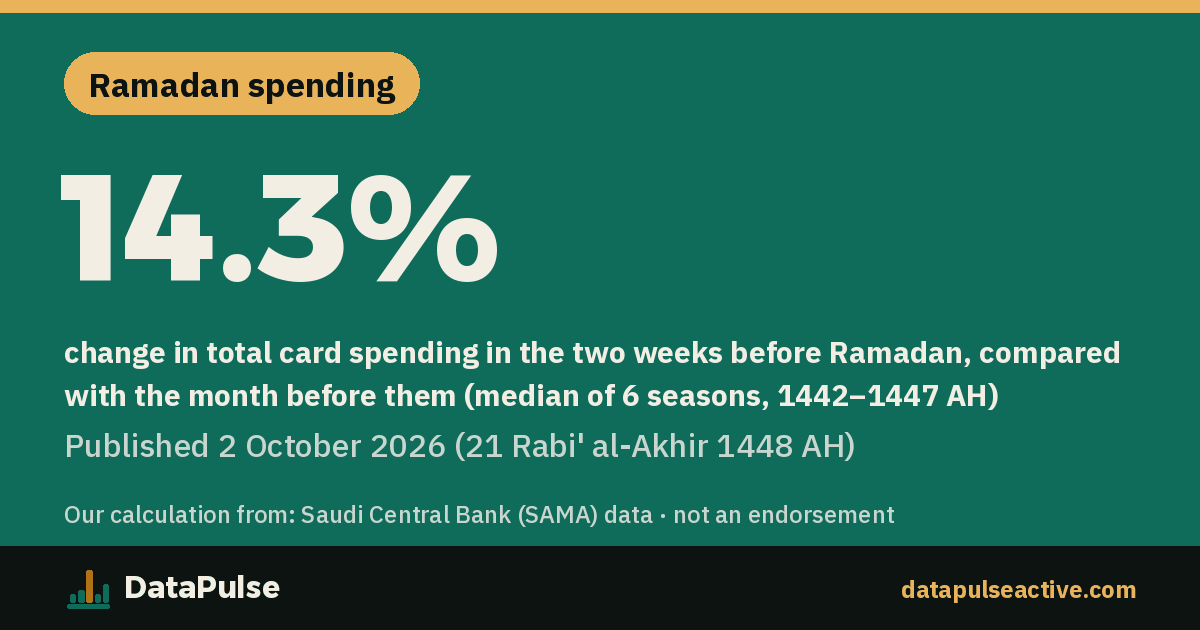
We reviewed 6 Ramadan seasons in the Saudi Central Bank’s weekly bulletins, from Ramadan 1442 (2021) to Ramadan 1447 (2026). In each season we compared card spending with its level about a month before Ramadan, that is, the average of the eighth to fifth weeks before the week in which Ramadan begins. The figure here is the median of the 6 seasons.
- In the two weeks before Ramadan, both in Sha’ban, total card spending rose 14.3%, and it rose in 6 seasons of 6. The median rose in 9 of the 9 activities in the table, most of all clothing and accessories 44.8%, then furniture and home supplies 28.5%, then food and beverages (groceries and supermarkets) 20.2%, then electronic and electrical devices 16.2%.
- In the first week of Ramadan the total returned close to its level before the month (0.5%). Spending at restaurants and cafés changed by −31.1%, and fell in 6 seasons of 6.
- In the last week before Eid al-Fitr the total rose 35.1%, and rose in 6 seasons of 6. The largest rise was in clothing, 246.5%, then jewellery, 145.9%, which rose in 6 seasons of 6.
Which activity moves, and when?
The table shows 9 activities and the total at three stages of the season. It shows the following:
Seasons are not identical. In Ramadan 1447 (2026) the total rose 8.0% in the two weeks before it, and groceries rose 20.3%.
- Shopping for the home comes before the month: groceries and furniture rise before Ramadan, then calm in its first week (groceries 5.6%), then furniture rises again before Eid, 34.1%.
- Restaurants and cafés fell in the first week of Ramadan in every season, and in the last week before Eid they were close to their level before Ramadan (3.0%).
- Clothing rises throughout the season: 51.6% in the first week of Ramadan, a rise in 6 seasons of 6, then it peaks before Eid.
- Some activities move little before Ramadan: fuel stations 3.1% and health 2.4%.
Shopping comes before Ramadan, restaurants are quieter at its start, and clothing peaks before Eid
Median of 6 Ramadan seasons (1442–1447 AH), compared with spending about a month before Ramadan.
| Activity | Two weeks before Ramadan | First week of Ramadan | Last week before Eid | Years with a rise before Ramadan |
|---|---|---|---|---|
| Total card spending | 14.3% | 0.5% | 35.1% | 6 of 6 |
| Food and beverages (groceries and supermarkets) | 20.2% | 5.6% | 8.2% | 6 of 6 |
| Furniture and home supplies | 28.5% | 4.1% | 34.1% | 6 of 6 |
| Electronic and electrical devices | 16.2% | 1.1% | 4.8% | 6 of 6 |
| Clothing and accessories | 44.8% | 51.6% | 246.5% | 6 of 6 |
| Jewellery | 14.6% | 16.7% | 145.9% | 6 of 6 |
| Restaurants and cafés | 7.8% | −31.1% | 3.0% | 6 of 6 |
| Culture and recreation | 8.6% | −10.4% | 39.5% | 5 of 6 |
| Fuel stations | 3.1% | −7.1% | 6.2% | 5 of 6 |
| Health | 2.4% | −0.6% | 17.0% | 4 of 6[2] |
What this means for your decision
These figures describe what happened in past seasons; they are not a forecast of what will happen in Ramadan 1448, nor of any particular shop’s sales.
- For shop owners: spending rose in the two weeks before Ramadan in all 6 seasons, and this time those two weeks fall in Sha’ban, before 8 February 2027 (1 Ramadan 1448 AH). For the total, the last week before Eid was higher than the two weeks before Ramadan.
- For restaurant or café owners: spending fell in the first week of Ramadan in all 6 seasons, then returned close to its usual level before Eid.
- For households: the figures show when shops are busiest: the two weeks before Ramadan, then the last week before Eid for clothing and jewellery.
Analytical reading, not financial advice.
Full official figures: Ramadan 1448: the full analysis(Arabic) · DataPulse calendar(Arabic) · All insights(Arabic)
Translated from the Arabic reading; the Arabic text is the original. The original reading(Arabic)